For the eighth consecutive day, Colombians took to the streets since the national strike began on April 28. Despite the fact that the tax reform that originated the protests has already been withdrawn, in the background there is widespread discontent. They ask for structural changes in the Police in the face of the increase in violence, they resist a health reform, they want the peace agreement that was signed in 2016 to be complied with -especially with regard to the protection of social leaders and of ex-combatants – and reject inequality and the increase in poverty.
As if it were a pot under pressure for years, the inequalities that Colombians have endured for decades have exploded in the government of Iván Duque. Under his Administration, several of the disagreements increased and the protesters say that they are not only marching to reject the fiscal reform plan that the Executive proposed and that has already been withdrawn due to social pressure.
“It is not about defeating a single law,” said psychologist Benjamin Paba, 53, during a march in Bogotá. He, for example, also protests for a better education and to demand the continuity of the peace process with the members of the former FARC guerrillas who laid down their arms. Like him, Colombians have taken to the streets for multiple reasons, including these five that we explain below:
1. A tax reform withdrawal that continues to cause concern
The tax reform was the last straw that broke the glass of Colombian patience. The bill sought a collection of around 6,302 million dollars and, to achieve this, it sought to increase taxes for the middle and lower class. This included a 19% increase in public services and basic products of the family basket, just at a time when closures to mitigate the pandemic have increased unemployment by more than 3%, according to the National Administrative Department of Statistics (DANE ).

On the second day of the national strike, Duque announced that he would not withdraw the reform. On the third day, he was willing to replace some of the most controversial points, such as the increase in VAT that was also going to apply to funeral services. On the fifth day of the protests, the president withdrew the entire project and, later, Finance Minister Alberto Carrasquilla resigned for being the promoter of the criticized plan.
However, Duque maintains that a new one was formulated. This time, based on “consensus” with the political parties. The president insists that a tax reform is needed to fill the holes in the public coffers, which have increased due to the health emergency, and guarantee the extension of social programs that he created to face the pandemic.
But not everyone agrees with a new project. “He withdrew, but in order to restructure it and the restructuring may be much more dangerous than the one that already exists,” said indigenous leader Aida Quilcué during a demonstration last Monday.
How would the reform look then? According to the Colombian president, the initial text of his project maintains some points from the past such as the temporary income surcharge for companies, temporarily extending the wealth tax, temporarily increasing the dividend tax, creating an income surcharge for people of higher incomes and deepen state austerity programs.
2. The violence of the public force rekindled the debate on a police reform in Colombia
The number of civilians killed during the protests varies depending on who is counting. While the state Ombudsman’s Office speaks of 24 deceased -including a policeman-, the local NGO Temblores assures that there are 37 fatalities. Some of them were killed by gunfire by police officers. And national NGOs and international organizations have warned of events related to human rights violations by the security forces in the framework of the protests.
.jpg)
On the other hand, violent acts by some civilians have also increased. On May 4, they set fire to a police station in Bogotá when there were uniformed men inside. The Ministry of Defense assures that at least 93 uniformed men have been injured with sharp weapons. There have also been looting of supermarkets, destroyed shops and incinerated public buses throughout the country during the mostly peaceful demonstrations.

With the recent complaints of police abuse, voices calling for a restructuring of the public force were rekindled. This is not a new claim, since the debate took hold in November 2019 when a riot police officer killed the young Dilan Cruz and was once again at the center of the discussion in September 2020, after the death of Javier Ordóñez in police custody.
The protesters are demanding reform that includes the dismantling of ESMAD, the Mobile Anti-Riot Squad. They also ask that the uniformed men who commit a crime be judged impartially and that in their operations they treat people as civilians and not as subversives. And it is that, unlike other countries, in Colombia the Police are part of the Ministry of Defense and are indicated to have training with an approach to fight against the armed conflict, specifically against the guerrillas.
Now, Defense Minister Diego Molano, against whom the opposition in Congress filed a motion of censure on Tuesday, amid allegations of abuse in the use of force against protesters, would also be under the tightrope.
3. The health reform also causes discomfort in Colombian protesters
This is another project that Congress is debating and that is common to hear in demonstrations. The Government presented it urgently, and the Ministry of Health ensures that the reform “focuses on improving the quality and access of services, promoting equity within a framework of sustainability.” But the opposition claims that it was not agreed with the citizens and that it would bring great disadvantages.
The proposal includes the regionalization of the health system that, according to its speakers, would guarantee that this service reaches all corners of the country. The reform also stipulates increasing quality standards so that there are fewer companies with better service. Although opposition lawmakers warn that the bill would give insurers more power and thus could consolidate their monopoly.
For example, opposition senator Jorge Enrique Robledo maintains that the new model would be similar to the one used in the United States, so users should pay their insurers as they already do and, in addition, pay for additional insurance policies for pathologies. Robledo insists that if the patient does not have them, they will not be treated.
4. A call for the assassinations of social leaders and ex-combatants to stop, and to comply with the peace agreement
Although this time it has not been a so-called protagonist in the protests, it is one of the reasons why many march. In 2016, the government of then-President Juan Manuel Santos signed a peace agreement with the then oldest guerrilla in Latin America: the FARC, now a political party.
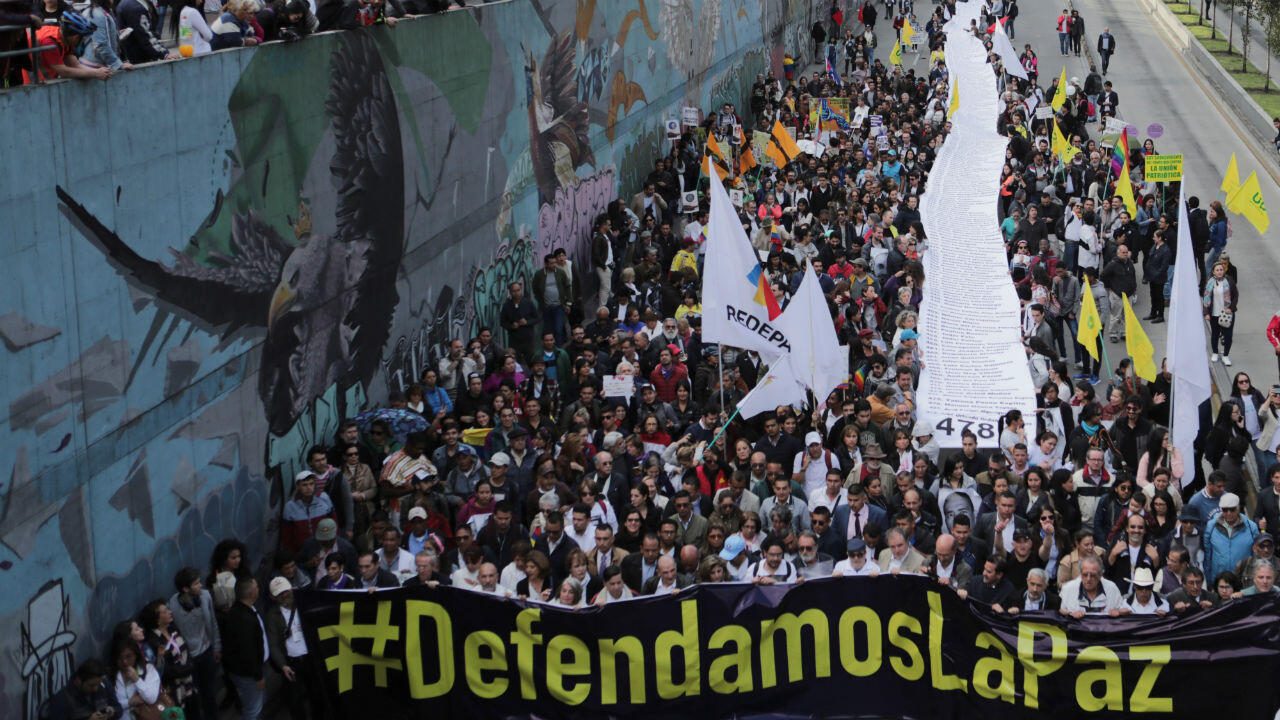
Now, the demobilized and citizens in general who supported the process ask that the commitments be fulfilled, especially the points referring to guaranteeing the life and safety of those who laid down their arms. Until the end of April, Comunes, the political movement of the former guerrilla, reported that 269 signers of the peace process had been assassinated.
Added to this are the deaths of social leaders. On April 20, the transitional justice mechanism – called the Special Jurisdiction for La Paz (JEP) – reported that at least 904 have been murdered since 2016. The lives of these people “are at high risk due to threats, homicides , disappearances, kidnappings, displacements and other attacks ”that they have suffered since the signing of the pact, said the organization.
Ensuring their safety seems to be one of the great points of conflict with the government that inherited the peace process. Legislators of the ruling party affirm that some of the dead ex-combatants lost their lives while committing crimes, which for many leaves their security adrift and the current Administration fails to comply with them. In contrast, the JEP says that 92% of the demobilized murdered did appear before transitional justice. For its part, the Duque Administration maintains that it has implemented what they call “peace with legality.”
5. Poverty and inequality, a general malaise in Colombia
A long-standing problem that has deepened even further with the pandemic. In March 2020, just before the lockdowns began, the unemployment rate in Colombia was already high at 12.6%. By February 2021, the figure rose to 15.9%, according to DANE.
.jpg)
The director of the official entity, Juan Daniel Oviedo, explained that during one year of the pandemic, about 468,000 people lost their jobs and the number of unemployed reached 3,437,000 in March 2021. In addition, the most recent report from the DANE assures that 40% of Colombians are now poor and 15% live in extreme poverty.
Faced with this difficult panorama and the social pressure with the new wave of protests, the president called a national dialogue table, but many of the protesters distrust what may be established there, since they affirm that the president has already breached the commitments he assumed in the past protests at the end of 2019.
With Reuters and local media
.
#reasons #protests #continue #Colombia
source https://pledgetimes.com/these-are-some-of-the-reasons-why-protests-continue-in-colombia/
Disqus comments